
The numbers are staggering. In just one week, crude oil prices have surged from $50 to over $90 per barrel following the escalation of Operation Epic Fury and the closure of the Strait of Hormuz. For American families, this isn’t just a headline—it’s a direct hit to the monthly budget. Understanding how oil prices 2026 affect your wallet is the first step to protecting your finances.
According to the U.S. Energy Information Administration (EIA), the national average gas price could hit $4.10-$4.50/gallon within weeks if the conflict persists. Some states may see prices even higher. This guide breaks down exactly what’s happening, why it matters, and what you can do about it.
• Crude oil price: $90 – $95/barrel (↑ 80% in one week)
• Current national gas average: $3.45/gallon
• Projected gas price: $4.10 – $4.50/gallon
• Increase for average family: $150 – $250/month
• Oil passing through Strait of Hormuz: 20% of global supply
1. From $50 to $90: How Oil Prices 2026 Exploded
The conflict with Iran has directly impacted the oil prices 2026 in two ways. First, the military operation (Operation Epic Fury) has created a risk premium—traders demand higher prices due to uncertainty. Second, and more critically, the Strait of Hormuz, through which 20% of the world’s oil passes, has become a war zone, disrupting actual supply.
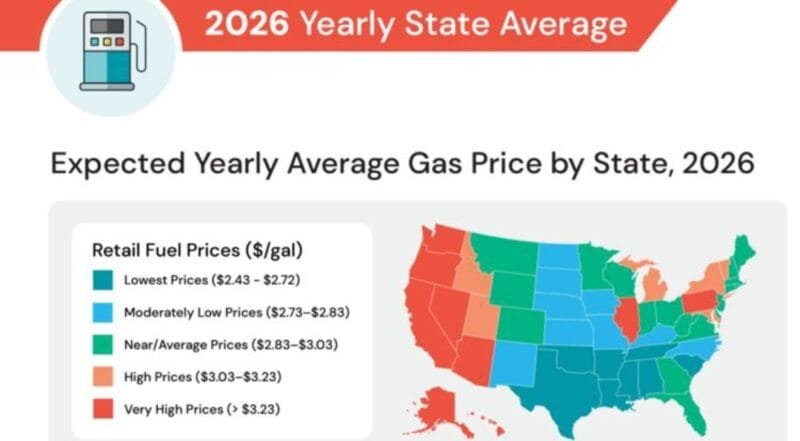
According to Reuters, this is the fastest surge in oil prices since the 1970s oil crisis. The chart above shows how this will translate to gas prices across different U.S. states in 2026. Some areas, like California and the Northeast, will be hit hardest, while states like Texas and Oklahoma may see slightly lower increases.
2. What This Means for Your Gas Budget
Let’s look at the real-world impact of oil prices 2026 on an average American family. Suppose you drive 12,000 miles per year in a car that gets 25 miles per gallon. That’s 480 gallons of gas annually. At $3.45/gallon (current), you pay $1,656 per year. At $4.50/gallon (projected), you pay $2,160—an increase of $504 per year, or $42 per month.
For a family with two cars, or a larger vehicle that gets lower mileage, the impact doubles or triples. Some households could see their fuel costs rise by $150-$250 per month. Use our Monthly Payment Calculator to see how this extra expense affects your overall budget.
3. Why the Strait of Hormuz Matters
The Strait of Hormuz is a narrow passage between the Persian Gulf and the Gulf of Oman. About 20% of the world’s oil—roughly 17 million barrels per day—passes through it. When the U.S. and Iran began military operations in the area, tanker traffic slowed, and insurance costs for shippers skyrocketed. Some companies have halted shipments entirely.
According to the EIA, this is the single biggest supply disruption in decades. Even if the conflict doesn’t last long, the uncertainty will keep oil prices 2026 elevated for months.
4. How Long Will High Oil Prices 2026 Last?
This depends entirely on the conflict. There are three scenarios:
- Quick resolution (1-2 weeks): Prices could drop back to $60-$70/barrel, but gas prices will lag behind. You might see $3.50-$3.80 for a few months.
- Protracted conflict (months): Prices could stay above $90/barrel, with gas at $4.00-$4.50 or higher. This would strain household budgets and potentially slow the economy.
- Escalation (wider war): If the conflict spreads, $100-$120/barrel is possible, with gas above $5.00 in some areas. This would be a major economic shock.
Most analysts currently expect the second scenario—a prolonged but contained conflict.
5. Practical Steps to Protect Your Budget
While you can’t control oil prices 2026, you can control your response. Here are actionable steps:
🚗 Reduce Fuel Consumption
- Combine trips: Plan errands to minimize driving.
- Maintain your car: Proper tire pressure and regular tune-ups improve mileage by 5-10%.
- Drive smoothly: Avoid rapid acceleration and hard braking.
- Consider carpooling: Share rides with coworkers or neighbors.
- Remote work: If your job allows, work from home even 1-2 days per week.
💰 Adjust Your Budget
- Track spending: Use our Savings Goal Calculator to see where you can cut back.
- Reduce discretionary spending: Dining out, entertainment, and subscriptions can be temporarily trimmed.
- Build an emergency fund: If you don’t have one, start now. Aim for $1,000 as a starter.
🏦 Review Your Loans
Higher fuel costs mean less money for other expenses. If you have variable-rate debt (credit cards, HELOCs), consider locking in fixed rates. Use our Refinance Calculator to compare options.
6. The Ripple Effect: Beyond the Pump
High oil prices 2026 don’t just affect gas—they affect everything. Transportation costs rise, so groceries, consumer goods, and online purchases become more expensive. Airlines raise fares. Home heating oil and natural gas prices also climb. According to the Federal Reserve, a sustained $20 increase in oil prices can reduce GDP growth by 0.5% and increase inflation by 1%.
This is why the current situation matters to every American, not just drivers.
7. What Experts Are Saying
We’ve compiled neutral, expert opinions on oil prices 2026:
- Goldman Sachs: “We expect Brent crude to average $85-$95 in Q2 2026, with risks skewed to the upside.”
- JP Morgan: “The disruption in the Strait of Hormuz could add $10-$15/barrel premium for months.”
- U.S. Energy Information Administration: “Gasoline prices could exceed $4.00/gallon nationally if the conflict persists.”
The Bottom Line: Stay Calm, Plan Ahead
The surge in oil prices 2026 is real, and it will affect your family’s budget. But panic won’t help. By understanding the situation, adjusting your driving habits, and reviewing your finances, you can weather this storm.
Use our calculators to model different scenarios and find the best path forward for your household. Remember, this too shall pass—but being prepared makes all the difference.
Frequently Asked Questions
⚠️ Important Disclaimers & Privacy
📊 No Data Storage: All calculations on Loan Logic Tool are performed 100% in your browser. We do not store, sell, or share any financial information you enter.
📈 Educational Purpose Only: The content on this website, including articles, calculators, and guides, is for informational and educational purposes only. It does not constitute financial advice. Loan Logic Tool is not a lender, broker, or financial institution, and we do not make lending decisions.
⚖️ Accuracy & Liability: While we strive for accuracy using current 2026 data from sources like the EIA, Federal Reserve, and Reuters, oil prices and market conditions change rapidly. The numbers and examples shown are estimates based on public data available at the time of writing. You should always consult with a qualified financial professional before making any major financial decisions.
🔗 External Links: This article may contain links to third-party websites (such as EIA, Reuters, government sites). These are provided for your convenience and do not constitute an endorsement. We are not responsible for their content, accuracy, or privacy practices.
📅 Last updated: March 2, 2026. For our complete policies, see our Disclaimer & Privacy Page.
Sources & further reading: U.S. Energy Information Administration (EIA), Reuters, Associated Press, Bloomberg, Federal Reserve, Goldman Sachs, JP Morgan, and our own library at Loan Logic Tool including Monthly Payment Calculator and Savings Goal Calculator.
Ready to adjust your budget? → Try the Monthly Payment Calculator