Published: April 3, 2026 | By Loan Logic Tool Financial Team
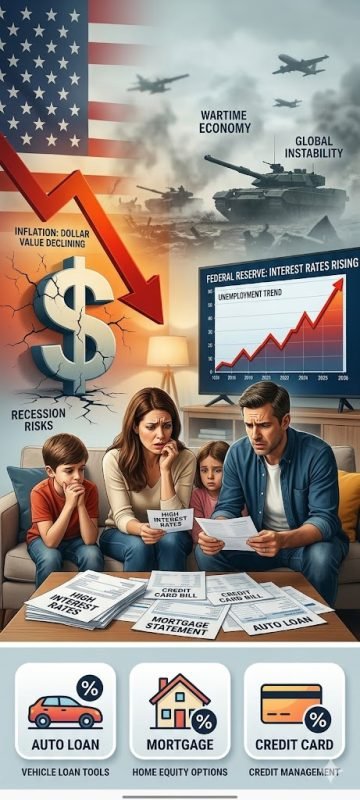
Your household budget revolves around one critical number: the amount you owe each month to lenders. In a war economy—marked by supply chain disruptions, energy price spikes, and the Federal Reserve’s highest interest rates in decades—that obligation is under direct attack. From adjustable-rate mortgages to auto loans and credit card minimums, the cost of debt is rising faster than most incomes. Understanding how geopolitical conflicts translate into higher required monthly outlays is the first step to protecting your financial health in 2026. This guide focuses on your monthly payment and how to shield it from global turmoil.
How War Directly Impacts What You Owe Each Month
When global tensions escalate, as seen in the ongoing Middle East conflict, crude oil prices surge. According to the U.S. Energy Information Administration, oil price spikes immediately raise transportation and production costs, fueling inflation. The Federal Reserve responds by maintaining or raising interest rates. Because most mortgages, auto loans, and credit cards carry variable rates, your monthly payment can increase within one to two billing cycles. For example, a $300,000 adjustable-rate mortgage with a 1% rate hike adds roughly $250 to what you owe each month. A $30,000 car loan with a 2% increase adds $50 per month. These “small” increases compound quickly, straining budgets already squeezed by higher grocery and gas prices.
The Anatomy of a Monthly Obligation in a War Economy
Every loan installment consists of principal and interest. In a war economy, the interest portion grows disproportionately because lenders price in risk. Credit card APRs, which are variable, can jump from 18% to 29% within months. According to the Federal Reserve, the average credit card APR in 2026 has reached 24.5%, the highest in two decades. If you carry a $5,000 balance, your required monthly payment at 24.5% APR (assuming 3% minimum) is about $150, but nearly $100 of that goes to interest alone. Over a year, that’s $1,200 in interest—money that could have been used for savings or emergency funds. This dynamic makes understanding your true monthly financial commitment essential.
3 Ways the War Economy Raises Your Debt Installments
1. Adjustable-Rate Mortgages (ARMs)
If you have an ARM, the amount you owe each month is tied to an index like SOFR. Geopolitical instability leads to higher long-term rate expectations, and your lender will adjust your rate at the next reset. Many homeowners who took 5/1 or 7/1 ARMs in 2020-2022 are now seeing their monthly payment jump by 40% or more. Use our Mortgage Calculator to compare your current obligation against potential rate hikes.
2. Auto Loans
New and used car prices remain elevated due to supply chain issues, and interest rates on auto loans have climbed. If you financed a vehicle with a 72-month loan, your monthly payment is fixed, but if you need to refinance or buy a new car, you’ll face higher rates. For those with variable-rate auto loans (rare but exist), the shock is direct. Our Auto Loan Calculator helps you see how rate changes affect what you pay each month.
3. Credit Cards
Credit card APRs are variable and can change with 15 days’ notice. In a war economy, issuers raise rates aggressively. A $10,000 balance at 18% APR has a minimum monthly payment around $300; at 29% APR, that same balance costs nearly $450 per month. This increase directly competes with food and fuel. Use our Credit Card Payoff Calculator to find the fastest way to reduce that monthly obligation.
⚠️ Financial Warning: Your Monthly Payment Is Not Fixed
Many borrowers assume their monthly payment is static, but variable-rate debts and inflation can change it overnight. Before the next Fed meeting, review all your loan agreements. If you have an ARM or variable credit card, consider locking in a fixed rate through refinancing. Use our Refinance Calculator to see how a fixed-rate loan could protect your monthly outlay from future hikes.
5 Strategies to Protect Your Debt Obligations in 2026
- Refinance Variable-Rate Debt: If you have an ARM or variable personal loan, refinance into a fixed-rate product now. Use our Refinance Calculator to compare costs and savings.
- Pay Down High-Interest Credit Cards: Reducing your credit card balance directly lowers the minimum amount due. Our Credit Card Payoff Calculator can show you the fastest path.
- Build an Emergency Fund: A cash reserve prevents you from missing payments if your income is disrupted. Use our Savings Goal Calculator to set a realistic target.
- Monitor Your Debt-to-Income Ratio: Lenders tighten standards during wars. Keep your DTI below 36% to maintain access to credit. Our DTI Calculator can help.
- Consider Debt Consolidation: If multiple high-interest debts are pushing your monthly obligations too high, a personal loan with a fixed rate may lower your total outlay. Our Debt Payoff Calculator can model this.
Stay informed with trusted sources like Reuters Finance and the Bureau of Labor Statistics to anticipate economic shifts that could impact your monthly financial commitments.
Frequently Asked Questions About Monthly Payments in a War Economy
Can my monthly payment increase even if I have a fixed-rate loan?
No, a true fixed-rate loan has a constant monthly payment for the life of the loan. However, property taxes and insurance (if escrowed) can change, affecting your total monthly housing cost. For credit cards and ARMs, the amount due can rise with interest rates.
How fast can my credit card monthly payment change?
Credit card issuers can change your APR with 45 days’ notice for new transactions, but existing balances may be grandfathered under the old rate depending on your card agreement. In practice, many issuers raise rates within two billing cycles after a Fed hike.
Should I pay extra each month to lower my monthly payment?
Paying extra reduces principal, which can lower future interest and shorten the loan term, but it does not reduce your contractual monthly payment unless you recast the loan (for mortgages). For credit cards, paying down the balance directly lowers the minimum due.
How does the Middle East war affect my auto loan monthly payment?
Indirectly, through interest rates. The war keeps inflation high, which keeps the Fed from cutting rates. If you have a variable-rate auto loan (rare) or are looking to finance a new car, your monthly payment will be higher than a year ago. If you already have a fixed-rate loan, your payment remains the same.
Final Verdict: Take Control of Your Monthly Financial Commitments Today
What you pay each month is not just a number—it’s your financial lifeline. In a war economy, every dollar counts. By refinancing variable debt, paying down high-interest balances, and using free tools to simulate rate changes, you can protect your budget from external shocks. The calculators on Loan Logic Tool are designed to give you clarity and control. Start today: check your mortgage with our Mortgage Calculator, your auto loan with our Auto Loan Calculator, and your credit cards with our Credit Card Payoff Calculator.
Disclaimer: The information provided in this article is for educational and informational purposes only and does not constitute financial, legal, or investment advice. Global economic conditions and interest rates change rapidly. Always consult with a licensed financial advisor or your lender before making major financial decisions. Loan Logic Tool is not a lender and does not make credit decisions. We may earn commissions from some partners, but this does not influence our content. Rates and terms are subject to change. Past performance does not guarantee future results.