Published: March 21, 2026 | By Loan Logic Tool Financial Team
As geopolitical tensions escalate and the Federal Reserve maintains its aggressive stance on interest rates, millions of American households are finding themselves trapped between rising living costs and mounting debt payments. The confluence of a global war economy and persistent inflation has created a perfect storm for borrowers. For those juggling multiple credit card balances, personal loans, or high-interest auto debt, the question is no longer whether to consolidate—but how to do so strategically before the next rate hike pushes monthly payments beyond reach. This debt consolidation 2026 war economy guide provides a roadmap to navigate these turbulent times.
Debt consolidation can be a powerful tool when executed correctly, but in a wartime economy characterized by supply chain disruptions, energy price volatility, and tightening credit conditions, the stakes are higher than ever. Making the wrong move—or failing to act at all—could mean the difference between financial stability and default. In this comprehensive debt consolidation 2026 war economy guide, we’ll walk you through the mechanics of debt consolidation in 2026, identify the best strategies for the current environment, and help you avoid the pitfalls that leave many worse off than when they started.
Why Debt Consolidation Matters in a 2026 War Economy: A Complete Guide
The term war economy isn’t just a metaphor. As we’ve explored in our analysis of the Middle East conflict’s financial impact, disruptions to global shipping routes and energy supplies have driven inflation higher for longer than expected. In response, the Federal Reserve has kept interest rates elevated, with the average credit card APR now exceeding 24% and personal loan rates hovering near 12% for qualified borrowers. For those with less-than-perfect credit, rates can be even higher. This debt consolidation 2026 war economy guide helps you understand why consolidating now can be a game-changer.
In this environment, carrying multiple high-interest debts is akin to swimming against a strong current. Each month, a larger portion of your payment goes toward interest rather than principal, extending your repayment timeline and increasing total cost. Debt consolidation—combining multiple debts into a single loan with a lower interest rate and a fixed repayment schedule—can reverse this dynamic, freeing up cash flow and providing a clear path to becoming debt-free.
According to data from the Federal Reserve, the average American household now carries over $9,500 in credit card debt. With rates at historic highs, the interest alone on that balance can exceed $2,300 annually. Consolidating that debt into a personal loan at 10% could save nearly $1,000 per year—money that can be redirected to an emergency fund or retirement savings. This is the core insight of any debt consolidation 2026 war economy guide.
How the War Economy Affects Your Debt Consolidation Options
This debt consolidation 2026 war economy guide must account for several factors unique to this moment. First, lenders are becoming more conservative. As we noted in our credit score 2026 forecast, tightening underwriting standards mean that borrowers with credit scores below 680 may find it harder to qualify for the best rates. Second, the shipping crisis continues to pressure household budgets, making it difficult to maintain the payment discipline required to pay off consolidated debt without falling back into the credit card trap.
Additionally, the Fed’s rate path remains uncertain. While some economists expect cuts later in 2026, others warn that persistent inflation could force another hike. This uncertainty makes timing critical. Locking in a fixed-rate consolidation loan now can shield you from future increases, while waiting could mean higher costs. A thorough debt consolidation 2026 war economy guide emphasizes acting before the next rate move.
⚠️ Critical Warning: Don’t Consolidate Without a Plan
Debt consolidation is not a magic solution. If you consolidate without addressing the spending habits that led to the debt, you risk running up new balances on old cards while still owing the consolidation loan. Before moving forward, create a realistic budget and commit to using credit only for emergencies. Use our Monthly Payment Calculator to see how consolidation fits into your overall cash flow.
3 Debt Consolidation Strategies for the 2026 War Economy
Not all consolidation methods are equal in a high-interest, high-inflation environment. Here are three approaches to consider, ranked by suitability for the current climate.
1. Personal Loan Consolidation
For borrowers with good to excellent credit (typically 680 or above), a fixed-rate personal loan is often the best option. Unlike credit cards, which have variable rates that can rise with Fed actions, a personal loan locks in a rate for the life of the loan—typically two to seven years. This predictability is invaluable in a war economy where interest rate forecasts are uncertain. Use our Personal Loan Calculator to compare rates and terms.
2. Balance Transfer Credit Cards
If you have strong credit, a balance transfer card offering 0% APR for 12 to 18 months can provide a window to pay down debt without accruing interest. However, this strategy requires discipline. Transfer fees (typically 3–5%) must be factored in, and you must pay off the balance before the promotional period ends to avoid deferred interest. This approach works best when you have a clear repayment plan and can commit to monthly payments that will retire the debt within the promotional window.
3. Home Equity Loans or HELOCs
For homeowners with significant equity, borrowing against your home can offer the lowest interest rates, often in the 6–8% range. However, this converts unsecured debt into secured debt—meaning default could put your home at risk. In a volatile economy, this risk should not be taken lightly. If you choose this path, ensure your job and income are stable and that you have a robust emergency fund.
5 Steps to Execute Debt Consolidation in 2026
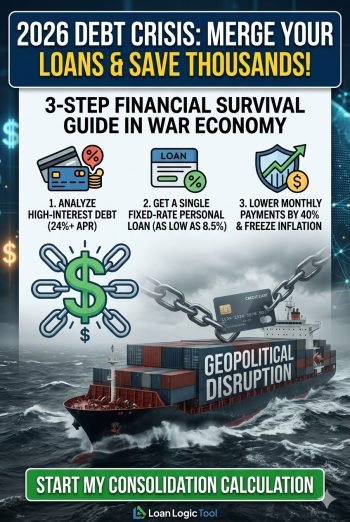
Following a structured process is essential to maximize the benefits of debt consolidation and avoid common mistakes. Use this checklist as your debt consolidation 2026 war economy guide:
- Audit Your Current Debt: List all your debts with balances, interest rates, and monthly payments. Include credit cards, personal loans, auto loans, and any other high-interest obligations. Our Debt Payoff Calculator can help you visualize the total picture.
- Check Your Credit Score: Your score determines the rates you’ll qualify for. If your score has dropped due to increased utilization, take time to improve it before applying. Use our Credit Score Estimator to know where you stand.
- Shop Multiple Lenders: Compare offers from online lenders, credit unions, and traditional banks. Credit unions often offer the most favorable rates, especially for existing members. Get pre-qualified to see terms without hard inquiries.
- Calculate the True Cost: Factor in origination fees (typically 1–8% for personal loans) and balance transfer fees. A lower rate isn’t always a better deal if fees eat up the savings. Use our Personal Loan Calculator to compare total costs.
- Create a Repayment Plan: Once consolidated, close most of your old credit cards or reduce limits to avoid running up new debt. Set up automatic payments to ensure you never miss a due date. Build a small emergency fund to cover unexpected expenses without resorting to credit.
For additional insights on managing debt during economic uncertainty, explore our Debt-to-Income Ratio Guide and Auto Loan Calculator. Staying informed through trusted sources like Reuters Energy News can also help you anticipate market shifts.
Frequently Asked Questions About Debt Consolidation in 2026
Is debt consolidation worth it in 2026?
Yes, if you can secure a rate at least 3–5 percentage points lower than your current weighted average APR and if you have the discipline to avoid new debt. The debt consolidation 2026 war economy guide emphasizes that consolidation is most effective when combined with a realistic budget and a commitment to living within your means.
Will debt consolidation hurt my credit score?
Initially, applying for a new loan will cause a small, temporary dip due to the hard inquiry. However, as you pay down the consolidated balance and reduce your credit utilization, your score is likely to improve over time. Paying on time and keeping old accounts open (without using them) further supports score recovery.
What’s the difference between debt consolidation and debt settlement?
Debt consolidation combines debts into one loan you repay in full. Debt settlement involves negotiating with creditors to accept less than you owe, which can severely damage your credit and may have tax consequences. Consolidation is generally the safer, more credit-friendly option, especially in a war economy where credit access may tighten.
Can I consolidate student loans and credit card debt together?
Generally, federal student loans should not be consolidated with consumer debt, as you would lose federal protections like income-driven repayment and deferment options. It’s best to keep them separate. A personal loan can consolidate credit cards and other unsecured debt while leaving student loans untouched.
Final Verdict: Consolidate Strategically to Weather the 2026 Storm
The economic landscape of 2026 presents real challenges, but also opportunities for those who act decisively. High interest rates make carrying credit card debt more costly than ever, while a war economy creates uncertainty that favors fixed-rate, predictable solutions. By following this debt consolidation 2026 war economy guide, you can reduce your monthly burden, lower your total interest costs, and regain control of your financial future.
Start today by auditing your debt with our Debt Payoff Calculator, checking your Credit Score Estimator, and exploring consolidation options with our Personal Loan Calculator. Every day you wait is another day you’re paying 24% interest on balances that could be costing you half that amount.
Disclaimer: The information provided in this article is for educational and informational purposes only and does not constitute financial, legal, or investment advice. Global economic conditions and interest rates change rapidly. Always consult with a licensed financial advisor or your lender before making major financial decisions. Loan Logic Tool is not a lender and does not make credit decisions. We may earn commissions from some partners, but this does not influence our content. Rates and terms are subject to change. Past performance does not guarantee future results.